
Certified Lash Artists vs Cheap Lashes in Washington, DC

A lower price doesn’t tell you whether a lash service is properly trained or carefully performed. When comparing a certified lash artist vs cheap lashes in DC, the key distinction is that certification reflects completed training and an exam, while a license permits legal practice under applicable rules.
It’s reasonable to weigh cost when choosing lash extensions. But certification alone doesn’t tell the whole story: training, application technique, and sanitation also shape the service experience. Certification requirements can vary by state and workplace, and some employers request certification even where it isn’t required.
This guide explains what lash tech certification means, how it differs from licensure, and what careful application and sanitation involve. You’ll also learn how to assess a lower-cost service without assuming price alone determines quality, so you can make a more informed choice for your lashes.
Table of Contents
Technician experience and careful application
Certification involves completing a course and passing an exam; licensure is a separate credential tied to legal practice. For Washington, DC clients, compare the artist’s training, application process, and sanitation practices rather than using price as the sole measure.
Comparing Provider Credentials
A certificate documents course completion and assessment, while a license comes through a state cosmetology board and permits work under that state’s rules. The National Institute of Standards and Technology describes a credential as evidence of achievement or skill measured against a standard. Look for the credential type, issuing organization, and the artist’s practical experience.
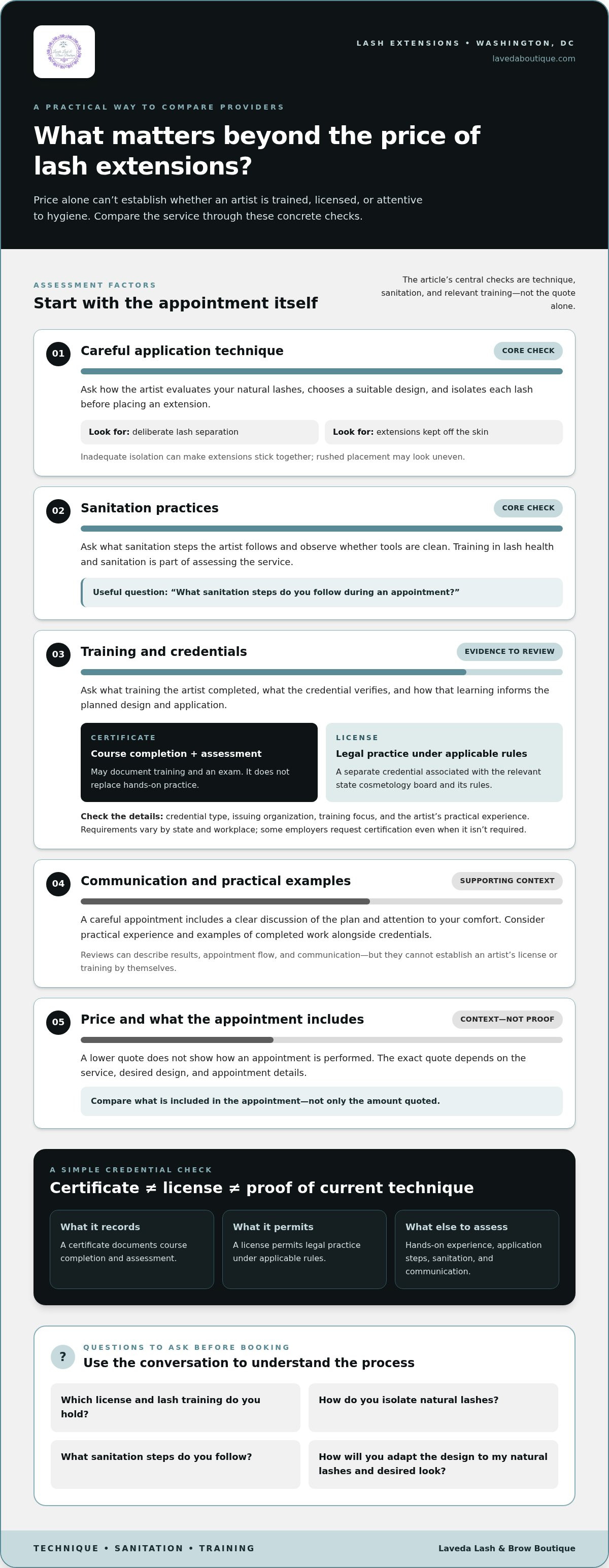
Certification exams can assess course learning, but they don’t replace hands-on practice. For extensions, ask how the artist evaluates natural lashes, selects a suitable design, and isolates each lash before attaching an extension. A careful appointment should include a clear discussion of the plan and attention to your comfort.
Assessing Application Risks
A low price alone doesn’t show how an appointment is performed. Inadequate isolation can cause extensions to stick together, while rushed placement may produce an uneven result. Focus on observable steps: clean tools, deliberate lash separation, and application that avoids attaching extensions to the skin.
Certification requirements vary by state and workplace, and some lash jobs request certification even where it isn’t required. A credential is useful context, but it doesn’t prove current technique by itself. Consider training alongside the artist’s explanation of their process and examples of completed work.
For a career, certification can support applications to salons that request documented training. Employers may also consider practical experience, communication, and the ability to follow sanitation procedures. Build confidence through supervised practice after training, then keep records of coursework and credentials to present during a job search.
Reviews of affordable and certified DC salons can describe clients’ experiences with results, appointment flow, and communication. They can’t establish an artist’s license or training on their own, so treat review details as one part of your assessment.
Before booking in Washington, DC, ask which license and lash training the artist holds, how they isolate natural lashes, and what sanitation steps they follow. Also ask how the artist will adapt the extension design to your natural lashes and desired look.
The exact quote depends on the service, desired design, and appointment details; the figure is provided for your case. Compare what the appointment includes, not only the quoted amount.
Ask which learning outcomes or skills the credential verifies and how that preparation informs the planned design. A credential documents achievement awarded by an authorized body and verifies learning outcomes or a level of knowledge or skill against a standard, according to the National Institute of Standards and Technology. Weigh that evidence alongside the artist’s practical explanation of application and sanitation steps.
Certification benefits for employment and clients
For a lash artist, certification can turn training into a credential employers can review. Some lash technician jobs request certification even in states where it isn’t required. A course certificate can be useful when applying to a salon, especially when an employer wants evidence of focused lash education alongside practical experience.
For example, an applicant can present the certificate with a résumé and describe the course skills it represents. The employer can consider training alongside a practical demonstration, work history, and client communication. Certification may strengthen an application, but it doesn’t replace hands-on ability or establish that every service will meet the same standard.
Clients gain a clearer starting point for evaluating an artist. A certificate shows that the artist completed a defined learning process and gives clients a specific subject to discuss, such as lash mapping or isolation. Look for the credential’s issuing organization and training focus, then connect those details to the service you’re considering.
For clients weighing the certified lash artist vs cheap lashes DC comparison, a certificate is one useful point of reference, not a complete measure of an appointment. Ask how the artist applies training during an eyelash extension service. For instance, ask how they choose a design for your natural lashes and separate each lash before placement.
Certification can also support career development beyond an initial salon application. An artist can add relevant coursework to a professional portfolio, then build experience through practice and client appointments. A portfolio with clear examples of different lash designs gives an employer more context than a certificate alone.
In Washington, DC, Yuliia is a licensed esthetician and lash artist with more than 20 certifications. Her credentials illustrate how artists may continue professional education after initial training. For clients, the certified lash artist vs cheap lashes DC decision is better informed by considering credentials alongside the artist’s ability to explain their approach.
Use certification as one decision point, not a guarantee of a particular result. Compare documented training, practical examples, and appointment communication. If you’re pursuing lash work, keep your certificate accessible and describe the specific skills you practiced. If you’re booking, ask how those skills shape the extension design and application.
Training in lash health and sanitation
Lash technician certification training covers lash anatomy, health, and sanitation. These subjects connect directly to an eyelash extension appointment: the artist works close to the eyes, handles tools, and applies extensions near natural lashes. Training helps artists understand the areas involved and build a methodical service routine. For clients, that knowledge offers useful context when assessing how an appointment is organized.
Lash anatomy matters because natural lashes differ in length, direction, and condition. An artist uses those details when planning placement and selecting extensions. For example, an extension design should account for the natural lashes available rather than treating every lash line as identical. A trained artist can explain how lash condition informs the plan before application begins.
Health training also helps an artist recognize when to pause and discuss discomfort or visible irritation. Before an appointment, share relevant sensitivities and describe any current eye-area concern. During the service, speak up if you experience discomfort. Clear communication gives the artist an opportunity to respond to your needs rather than continuing without discussion.
Sanitation training turns cleanliness into a sequence of actions, not just a visual impression. Notice whether the artist prepares the work area, handles tools carefully, and keeps items intended for one-time use separate. A clean-looking setup is one observation; how tools and supplies are handled throughout the appointment provides more context.
Before application: Notice how the artist prepares the station and organizes tools.
During application: Observe whether tools are handled deliberately and kept organized.
At the end: Notice whether used materials are separated from clean supplies.
Certification doesn’t make every artist’s routine identical. Training gives the artist a foundation, while ongoing practice shapes how that knowledge appears during a beauty service. An artist should be able to describe the sanitation steps used before, during, and after an appointment in clear, practical language.
Use specific questions to understand the process. Ask how the artist prepares tools, manages supplies during application, and adapts the appointment if you report sensitivity. The answers should describe actual steps rather than relying only on a certificate or a general claim of cleanliness. This helps you compare services using observable details.
Certification is one part of the decision. Consider how the artist applies knowledge of lash anatomy, responds to your concerns, and maintains an orderly setup. Those concrete details help you assess whether the appointment feels considered from preparation through cleanup, without treating a credential as a substitute for careful practice.
What is the difference between certified and unlicensed lash artists?
Certification and licensure are different credentials, so don’t treat the terms as interchangeable. A certification may offer context about an artist’s training, but it does not by itself explain the scope of that training. A licensed artist has obtained a credential through a state cosmetology board that permits legal work in that state. One person may hold both, but a certificate alone is not a license.
For Washington, DC appointments, identify which credential you’re evaluating. Certification records training achievement; licensure relates to legal authorization to work. Requirements vary by state and workplace, and lash services may require an esthetician or cosmetology license. The practical distinction is clear: training and permission to practice answer different questions.
An artist described as “unlicensed” lacks the relevant state license. That label doesn’t establish whether the artist has completed a separate certification course. Likewise, “uncertified” doesn’t automatically mean the person lacks a professional license. Ask what each term refers to, then assess the credentials separately.
Certification: Ask which institute provided the course and exam.
Licensure: Ask which professional license authorizes the artist’s work.
Application: Ask how training informs lash mapping and placement.
Practice: Ask how the artist builds and maintains hands-on experience.
These distinctions matter for employment, too. Some lash technician jobs request certification even where it isn’t required. A certificate can document relevant education for an employer, while a license addresses a separate requirement for legal practice. During hiring, employers can consider both credentials alongside practical skill and communication.
For clients, credentials provide useful context, not a complete measure of the appointment. An artist who explains how training shapes a design gives you more information than a label alone. For example, ask how the artist will consider your natural lashes before choosing an extension style. Then consider whether the explanation is specific to your needs.
Use a simple sequence before booking: clarify whether the artist holds a license, ask about lash-specific certification, and discuss the application plan. Keep the questions distinct. “What license do you hold?” addresses legal authorization. “Which course and exam did you complete?” addresses certification. “How will you plan my lash design?” addresses technique.
When comparing a certified artist with an unlicensed one, don’t assume certification and licensure mean the same thing. One documents course-based learning; the other grants permission to work under state rules. A careful comparison considers both credentials and the artist’s ability to explain a suitable, deliberate application process.
What are the risks of getting lash extensions from a cheap or unlicensed provider?
A low price alone does not establish poor technique, and a higher price alone does not prove skill. Practical risks arise from the service process: inadequate training, rushed placement, weak sanitation, or working without the required license. In Washington, DC, lash technicians must have an esthetician or cosmetology license to perform lash services.
Most states require a cosmetology or esthetics license for lash services. Licensure matters because it governs whether someone may legally perform the work in that state. Certification is different: it documents course training and an exam, but doesn’t replace the license. Treat a claim of certification as distinct from proof of authorization to practice.
Application technique can affect both appearance and comfort. If extensions are attached to multiple natural lashes instead of separated individually, for example, those lashes may pull against one another as they grow. Rushed placement can also create an uneven lash line or an uncomfortable sensation. Ask the artist to explain their isolation and placement process before application begins.
Sanitation is another practical concern. Poor handling of tools or supplies can compromise a clean service setup. Look for a prepared workstation, organized supplies, and careful handling throughout the appointment. A clean appearance at the start is only one part of the process; observe whether the artist keeps clean and used materials separate as work continues.
Use these signs to assess the service before booking:
The artist can explain their license and lash-specific training clearly.
The application plan accounts for your natural lashes and desired design.
The workstation and tools appear organized and are handled deliberately.
The artist invites you to describe discomfort or sensitivities before starting.
Price is only one detail to weigh. A lower quote may reflect differences in the service, appointment details, or design, but it can’t tell you how the artist will work. Compare the process and credentials instead. If an artist can’t explain their training, license, or approach to isolation, you have less information for making a confident choice.
For lash extensions, prioritize clear answers about licensing, application, and sanitation over a bargain alone. Review the lash extension service as a next step if you’re seeking a considered appointment.
One useful distinction is what the service involves: lash extensions are described as single lashes applied to each natural lash by a certified technician. That placement method is worth discussing before you agree to an appointment. Ask how the technician will work with your natural lashes and whether the proposed design accounts for them. Certification alone doesn’t replace the state license discussed above, so consider both rather than treating either as complete reassurance.
Professionals should always practice what they learned immediately after certification and continuous skill development. Ask about hands-on experience as well as whether a certificate was earned, and invite the provider to explain their training and approach clearly. The eyelash extension market was expected to grow by 569.8 million from the time of the page’s publication through 2027. That growth figure gives market context, but it cannot establish that any individual provider is licensed, experienced, or careful. Your choice should still rest on the credentials and service process you can assess before booking.
Laveda Lash & Brow Boutique: Lash Extensions
Laveda Lash & Brow Boutique offers Lash Extensions for readers seeking a professional appointment after comparing training, application, and sanitation. Choose this service when you want extensions and value a considered approach to your lash design. Share your preferred look and any sensitivities before the appointment so the artist can understand your priorities.
If you’re weighing extensions against a different beauty option, a Lash Lift may also suit your goals. The right choice depends on the look you want and the service you’re considering. Focus your decision on your needs, not price alone.
For details about Lash Extensions or to discuss your next step, contact Laveda Lash & Brow Boutique or visit lavedaboutique.com.
Choose Your Next Lash Appointment with Confidence
Let your next step reflect the experience you want, not just the quickest booking. The certified lash artist vs cheap lashes in DC decision is ultimately about choosing an appointment that aligns with your priorities and comfort. Consider the look you want, then choose the service that supports it.
Laveda Lash & Brow Boutique offers Lash Extensions and Lash Lift for different lash goals. Mani Pedi is also available if you’re planning a broader beauty appointment. Select the service that feels right for you and start a conversation about your next visit.
Contact Laveda Lash & Brow Boutique to explore your options. Make your next appointment a considered choice, and enjoy moving forward with confidence.
Frequently Asked Questions
What is Lash Tech Certification?
Lash tech certification is a course-based credential that records training and successful completion of an exam. The course may cover lash application concepts and related professional skills. The National Institute of Standards and Technology describes a credential as evidence of achievement or knowledge measured against a standard. For an appointment in Washington, DC, distinguish this training certificate from a professional license, which serves a different purpose.
What licensing or certification is required for lash artists in Washington, DC?
Lash artists performing lash services need an esthetician or cosmetology license under the stated licensing rule; certification is separate, and its requirements can vary by state and workplace. For a DC appointment, ask which license authorizes the artist’s work and which lash course they completed. If you’re comparing services around Arlington, Virginia, keep the appointment’s state jurisdiction in mind because licensing rules relate to the state.
What hygiene and sanitation standards should a DC lash studio follow?
Focus on clear, repeatable hygiene practices rather than a general claim that a studio is clean. Ask how reusable tools are handled between clients, where clean supplies are stored, and how single-use items are discarded. Notice whether the workstation is prepared before your appointment and remains organized during it. These practical observations help you understand the studio’s routine without assuming one visible detail tells the whole story.
How can I verify a lash artist’s license or credentials in DC?
Ask the artist to identify the license type and issuing authority, then review the credential details directly. For certification, request the course provider’s name and the credential showing completion. Keep the two records distinct: a course certificate documents training, while a professional license relates to authorization to practice. In Washington, DC, or Arlington, match the license information to the location where your appointment takes place.
What do lash extension reviews say about affordable versus certified DC salons?
Reviews can describe clients’ experiences with results, appointment flow, and communication at affordable or certified salons. They can’t establish an artist’s license or training on their own.

I liked the simple feel of this write up because the message kept the content focused. It had a good balance with a natural style. 24 hour mobile mechanic
Love this breakdown! It’s so true that investing in certified lash artists is crucial for both safety and quality. Maybe consider adding tips on how to choose the right artist next time? It would also be fun to see how creative beauty trends connect with popular gaming culture, such as fnaf!
I like when a guide about the YayWin Game explains the important points without making the reader go through repeated descriptions. Details about the interface, account access, and platform rules can be presented in a logical order so that beginners can follow along. It is also important to check the applicable terms before using any feature that involves deposits, bonuses, or other financial commitments.
I genuinely liked this article because it felt natural and easygoing, which kept the writing natural. It was pleasant to read without extra noise. foggy glass replacement
Always interesting to compare different perspectives and see how approaches evolve across industries. Looking forward to reading more content like this.